The Living Spiral: Relational Intelligence, Human Systems, and the Long Arc to Exponential Impact
By Elizabeth (Liz) Ngonzi, MMH
The Moment of Recognition: From Movement to Equation
Outdoors, overlooking the Statue of Liberty, clarity arrived during a Tai Chi session. As the group moved through slow, spiraling forms, our instructor offered a simple observation: all energy contains information. The phrase landed not as metaphor but as recognition. In that moment, the boundaries between movement, memory, possibility, and the invisible currents of technology dissolved. Intelligence revealed itself not as linear or static, but as something alive, relational, and in motion.
Wisdom, I realized, does not reside only in data. It emerges through energy shaped by context, relationship, and intention. That moment did not introduce a new idea into my life. It named something that had been forming across decades of lived experience, global movement, technical work, teaching, leadership, and ethical inquiry.
From that recognition emerged a simple but powerful equation:
1+1+AI=10™
Not as math.
Not as hype.
Not as acceleration for its own sake.
But as coherence.
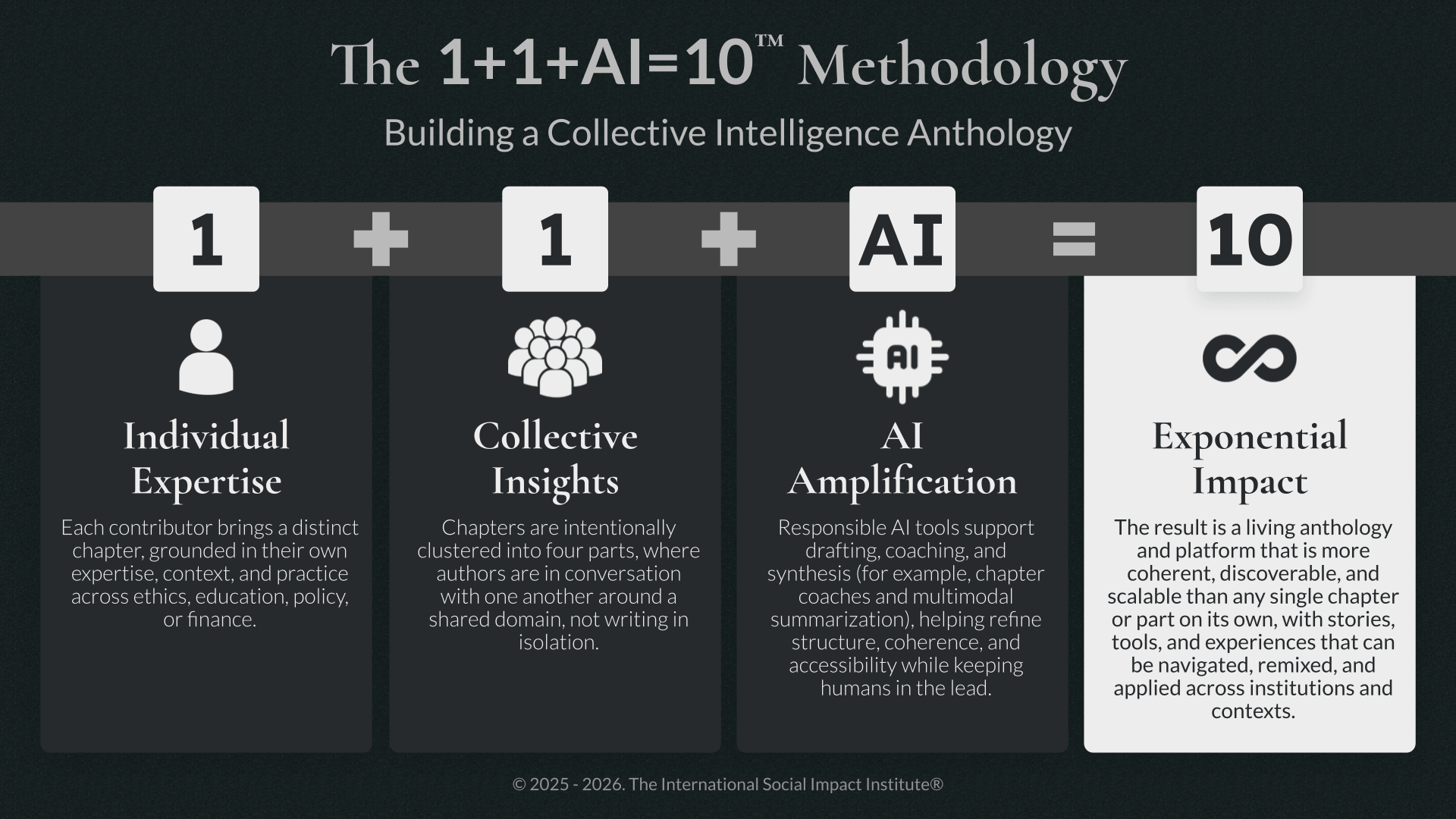
1+1+AI=10™ describes a pattern I had seen repeatedly: one person’s expertise, plus another’s complementary perspective, plus AI used deliberately, can produce outcomes neither could reach alone. In AI for Humanity, that equation appears everywhere, from co-authored chapters supported by the 1+1+AI=10 Chapter Coach to human-curated AI summaries and interactive experiences grounded in verified content.
From Equation to Application: How to Apply 1+1+AI=10™
While 1+1+AI=10™ may appear simple, its impact depends entirely on how it is applied. The equation is not about adding more technology. It is about designing better relationships between people, perspectives, and systems.
In practice, this can be understood as a four-step approach:
Step 1: Identify the “1+1”
Start with people, not tools. What two perspectives, disciplines, or lived experiences need to come together? Where is there complementary insight—or productive tension—that could lead to something new?
Step 2: Define the Role of AI
Determine how AI will support the collaboration. Will it synthesize information, identify patterns, simulate scenarios, or expand creative exploration? Clarity here ensures AI is used intentionally rather than reactively.
Step 3: Design for Co-Creation
Establish how humans and AI will work together. What decisions remain human-led? Where does AI enhance speed, scale, or insight? The goal is not automation alone, but thoughtful augmentation.
Step 4: Evaluate the “10”
Assess what becomes possible as a result. What outcome, insight, or capability emerged that would not have existed otherwise? This is the measure of exponential impact—not just efficiency, but transformation.
This approach is already embedded throughout AI for Humanity—from co-authored chapters supported by AI, to interactive tools that allow readers to explore, question, and extend ideas in real time. The equation is not theoretical. It is a design principle for building systems that are more collaborative, more adaptive, and more human-centered.
Together, these patterns are not separate ideas, but expressions of the same underlying logic. What follows is not only an origin story. It is the organizing logic that holds AI for Humanity together.
The Living Spiral Framework: Designing Relational Intelligence in Motion
The Living Spiral is not only a metaphor. It is a model for how intelligence evolves across people, systems, and time. It reflects a shift away from static, linear thinking toward a more relational, adaptive, and continuously learning approach to human-AI collaboration.
At its core, the Living Spiral Framework describes how exponential outcomes emerge when human insight, complementary perspectives, and AI are intentionally brought into alignment.
It can be understood through five interconnected stages:
- Origin (Story & Context)
Every system begins with human experience. Lived reality, cultural context, and values shape what is seen, prioritized, and acted upon. Without this grounding, intelligence becomes abstract and disconnected from impact. - Connection (Relational Intelligence)
When perspectives meet, something new becomes possible. This is the first “1+1”—the intersection of expertise, disciplines, or lived experiences. The quality of this connection determines the potential for meaningful collaboration. - Augmentation (AI as Amplifier)
AI enters not as a replacement for human thinking, but as an amplifier of it. At this stage, AI helps surface patterns, expand possibilities, and accelerate synthesis—guided by human intention and oversight. - Amplification (Exponential Outcomes)
This is where 1+1 +AI becomes 10. The combined system produces insights, solutions, or actions that neither humans nor AI could achieve independently. - Reflection (System Memory & Evolution)
The spiral continues through reflection. What is learned is retained, refined, and reintroduced into future cycles. This is how systems begin to “remember what matters” and evolve with integrity over time.
The Living Spiral Framework is not linear. It is continuous. Each cycle deepens intelligence, strengthens alignment, and expands impact.
Across AI for Humanity: Human-Centered Strategies for Innovation and Impact, this pattern appears repeatedly—in how chapters are developed, how insights are synthesized, and how the platform evolves as a living system.
This pattern is already in practice. AI for Humanity itself is an expression of it. What began as individual expertise across disciplines—policy, education, finance, ethics—was brought into alignment through intentional collaboration and AI-supported synthesis. Contributors brought lived knowledge. AI tools supported pattern recognition, drafting, and integration. Human editorial judgment ensured coherence, accuracy, and alignment with our values. The result is not simply an anthology, but a living system—one that continues to evolve, reflect, and extend the work of its contributors across contexts. This is what 1+1+AI=10™ looks like at system scale.
It is both the product and the proof of the methodology.
The 1+1+AI=10™ Methodology shows how individual authors, part-level cohorts, and AI-enabled synthesis combine to create an anthology with impact far beyond any single chapter or domain.
Early Spirals: Lineage, Migration, and Global Systems
My relationship with systems began long before my professional career. I was born in Uganda and crossed continents before the age of five when my mother, a diplomat, accepted her post at the United Nations. Movement was not optional. Adaptation was not abstract. Global systems were not something I studied later; they were the conditions of my childhood.
My mother’s work exposed me early to how institutions, networks, and people intersect. Through global initiatives such as NetAid, I saw how technology, storytelling, and coordinated action could mobilize resources and attention across borders, and I also saw their limits. Platforms alone do not create change. People do.
From my late father, Dr. John Ruganda, one of East Africa’s most influential playwrights, I inherited an understanding that storytelling is not decoration. It is ethical architecture. Stories shape what societies remember, what they value, and how they act. Narrative is not downstream of power. It is upstream of it.
I came of age at the United Nations International School in New York City, where diversity was not a slogan but daily reality. Enrolled in the bilingual gifted program, my education emphasized complexity, collaboration, and intellectual humility. I graduated in the General Assembly Hall as Carl Sagan spoke about the cosmos, reinforcing an intuition that science, narrative, ethics, and service were not separate domains, but interdependent ways of understanding reality.
These early spirals of movement, culture, and systems gave me the human side of 1+1+AI=10™ long before AI became part of the equation.
Inside the Machine: Learning Stewardship at Digital Equipment Corporation
I began my professional career in 1992 at Digital Equipment Corporation (DEC). This matters. DEC was foundational to modern computing infrastructure long before social media, cloud platforms, or public discourse about artificial intelligence. Working inside DEC meant understanding computing not as interface or abstraction, but as infrastructure.
Systems had to work. Failures had consequences. Design decisions traveled downstream into organizations, economies, and lives. At DEC, I learned systems thinking as responsibility. Technology was not something you shipped and forgot. It was something you stewarded because people depended on it.
As I moved into roles producing hundreds of tech-enabled events and digital experiences across corporate, nonprofit, academic, and public-sector contexts, I was often positioned as a translator between worlds that did not naturally speak to one another: technologists, executives, educators, activists, funders, and policymakers. These programs required stakeholder alignment, narrative clarity, cultural fluency, technical coordination, and ethical judgment, often simultaneously.
By 2009, I was teaching digital storytelling, helping professionals and institutions navigate emerging platforms without losing purpose, accountability, or memory. Patterns became impossible to ignore. Tools advanced faster than judgment. Systems scaled faster than ethics. Technology promised connection, yet often stripped away context and responsibility. Rather than stepping away from technology, I leaned further into it.
Leadership, Impact, and Ethics in Practice
My work eventually led me into global leadership, including serving as CEO of Afrika Tikkun USA, where I worked across the United States and South Africa on education, youth development, and cross-cultural capacity building. In these environments, ethics were not abstract. Questions of power, consent, narrative ownership, and long-term impact were lived realities.
Technology could amplify outcomes, but only when guided by human judgment and community wisdom. When it was not, harm followed quickly.
Across years of practice, teaching, facilitation, and leadership, structured methodologies began to emerge. Long before generative AI, I developed and applied frameworks that integrated inspiration, connection, activation, and transformation. These would later crystallize into SHINE™, AMPLIFY, and ultimately 1+1+AI=10™, each designed to keep human dignity and systems thinking at the center of innovation.
AI did not create these frameworks. It revealed why they were necessary.
From Response to Architecture: The International Social Impact Institute®
The Institute supported changemakers across six continents navigating crises through digital storytelling and strategy, and later through early AI-curious exploration, bridging nonprofits, academic institutions, UN-adjacent organizations, and mission-driven enterprises.
We did not deliver generic toolkits. We co-created strategies shaped by local context, on-the-ground experience, and continuous feedback.
As generative AI matured in 2023, The ISII integrated it intentionally into both client engagements and internal workflows, applying the pattern that would later become 1+1+AI=10™ at organizational scale. In 2025, I formally named and codified this approach as the 1+1+AI=10™ methodology, making the underlying logic explicit for others to use and adapt. By 2025, we also launched a suite of AI collaborators, including AmplifyGPT, Liz Ngonzi ∞ Human-Centered AI Guide, and The ISII Digital Twin, each designed to reflect and preserve human wisdom rather than replace it.
The specific tools matter less than the design principles: bounded data, human accountability, clear attribution, and values-aligned prompts.
Human judgment remained central. Our Creative Lead brought artistic vision and technical fluency, while partner consultants and advisors contributed specialized expertise across sectors. AI tools supported research synthesis, scenario planning, curriculum drafting, and personalized learning journeys, but decisions stayed human. The result was not automation. It was amplification.
Teaching the Spiral: NYU as Living Laboratory
As an Adjunct Assistant Professor at NYU’s School of Professional Studies, where I have taught for over a decade, my classrooms became laboratories for integrated intelligence. Students from across continents brought lived knowledge into dialogue. Together we tested how digital tools, storytelling, and AI could extend, rather than erode, our capacity to think and act with integrity.
My course, AI for Impact: Boost Your Marketability and Organizational Growth, became a proving ground for the methodology. Professionals from healthcare, philanthropy, business, education, and the creative industries used tools such as Gamma, Udio, ChatGPT, Perplexity, and Canva Magic Design, guided by SHINE™ and supported by the AI for Impact Project Coach™.
The outcomes were tangible: AI‑powered digital storytelling campaigns for young learners, healthcare workflow strategies balancing efficiency with patient experience, and hospitality concepts redesigning customer journeys through narrative‑driven AI applications. With over 90 percent of participants rating the course highly, the results confirmed what decades of work had already shown: when individual expertise, collective learning, and ethical AI amplification converge, transformation follows.
From Framework to Platform: AI for Humanity
AI for Humanity extends this work into a public, living system. I originated the initiative within the American Society for AI (ASFAI), where it began as a collaborative anthology and has evolved into an AI-powered platform and living body of work demonstrating how artificial intelligence can be designed, governed, and applied to strengthen human judgment, leadership, and accountability.
The platform is structured around four core parts reflecting the systems where AI is already reshaping decisions:
- Ethics & Responsible AI
- Education & Workforce Transformation
- Policy, Regulation & Legislation
- Finance, Technology & Investments
Each chapter is released as its own digital page, with clear guidance on who it serves and which questions it helps answer. After an initial “version 0” build and feedback cycle, the first full set of chapters was published together so ideas would launch in a coherent, integrated form while still remaining revisable over time. Featured chapters from each part are spotlighted on the home page, including this one, so visitors can quickly sample perspectives across sectors.
AI for Humanity is intentionally multiformat and multimodal. It combines a four-part digital anthology, an interactive Gamma site, NotebookLM-powered video and podcast overviews, AI-assisted chat experiences grounded in verified content, and an AI-composed anthem guided by human creative direction. Throughout the platform, AI-generated black-and-white imagery is contrasted with full-color photos of contributors to reinforce a simple point: people are at the center of this work, with AI as a supporting tool.
This chapter, The Living Spiral, serves as both the opening to Part 1 and the spine of the entire initiative. It invites readers to see AI for Humanity not as a static book about responsible AI, but as a living proof-of-concept for human and AI collaboration in practice.
Frameworks as Editorial Backbone: 1+1+AI=10™ and SHINE™
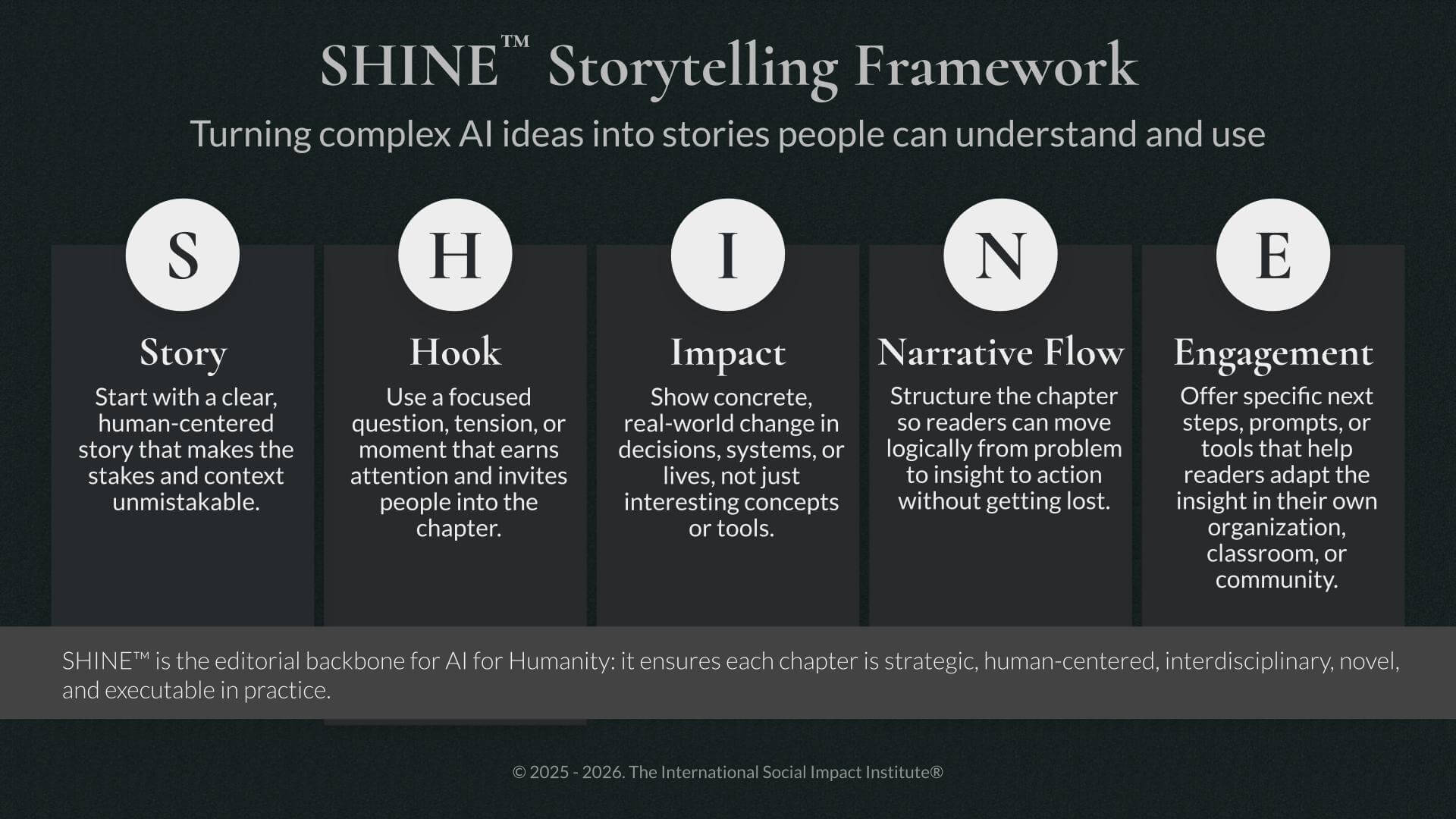
Two frameworks shape both the content and infrastructure of AI for Humanity. The first is 1+1+AI=10™, a methodology for exponential, ethical impact that combines individual insight, collective wisdom, and AI-powered amplification. The second is the SHINE™ Storytelling Framework, which asks whether each contribution delivers Story, Hook, Impact, Narrative Flow, and Engagement.
Every chapter, summary, and interactive element is evaluated using SHINE™ – from author essays to NotebookLM-generated video and podcast scripts. The 1+1+AI=10 Chapter Coach, powered by The ISII, helped contributors sharpen structure, clarity, and values alignment while preserving authentic voice. Grammarly added another layer of clarity and tone support. Live office hours, coaching, and peer review ensured AI never replaced human authorship, but served instead as mirror, amplifier, and prompt for deeper thinking.
To keep each chapter not only insightful but truly usable, we reviewed contributions against the SHINE™ Storytelling Framework, a rubric I developed to turn complex AI ideas into stories people can understand and apply.
Human + AI in Practice: How the Platform Was Built
One core design choice was to make the build itself part of the message. The platform’s “Built by Humans with AI, About AI, For Humanity” section documents how tools were used and how humans stayed in the loop. What matters here is not novelty, but governance.
Each tool is named alongside the type of support it provided:
- 1+1+AI=10 Chapter Coach for structure and values alignment
- Adobe Firefly and Canva Magic Studio for visuals and creative assets
- Gamma for visual storytelling and a collaborative layout hub in which all elements are housed
- ChatGPT and Perplexity for ideation, clarity editing, and research synthesis
- NotebookLM for video overviews, podcasts, and grounded multilingual and multigenerational chat experiences
- Echo chatbot for navigation, interaction, and multilingual guidance
- Grammarly for readability and tone refinement
- Suno for the AI for Humanity anthem under human creative direction
Public-facing AI experiences are constrained to verified anthology and ASFAI materials. All usage operates under human-in-the-loop oversight, attribution requirements, and safeguards designed to minimize hallucinations and misrepresentation. The result is a practical model for institutions seeking to build responsible AI ecosystems where accountability is explicit and traceable.
Platform to Practice: Davos as Live Case
In parallel with the anthology, the Liz Ngonzi @ Davos case hub applies these principles in a live, high-stakes environment. Designed to synthesize conversations, interviews, and emerging themes during Davos, it combines on-the-ground human insight with AI-assisted pattern recognition in real time.
The same stack underpins this work: structured human notes, AI-assisted synthesis, editorial framing guided by SHINE™, and explicit governance around source inclusion. The goal is coherence, not volume. Ethical amplification, not speed alone. Davos becomes a proving ground for how Human + AI systems can support leaders navigating complexity without sacrificing nuance or accountability.
Governance and Stewardship: ASFAI’s Role
AI for Humanity is produced under the auspices of the American Society for AI (ASFAI), where I serve as a Board Member and Founding Chair of the Ethics & Responsible AI Committee. From the beginning, the project has been as much about governance as content.
Contributors from five continents and disciplines engage through chapters, interviews, thematic conversations, and AI-assisted synthesis within an editorial process emphasizing relevance, clarity, and practical application. The anthology’s four parts echo ASFAI’s mission to steward ethical, human-centered AI across sectors.
This distributed yet governed model reflects a core premise: collective intelligence, when responsibly structured and augmented by AI, produces deeper insight than isolated expertise alone. My role has been to help ensure every layer of the system remembers what matters, not just what is measurable.
The Living Spiral: Invitation and Next Experiments
The 1+1+AI=10™ equation is not a metaphor to admire from a distance. It is a lived practice. As technology accelerates, the central task is not velocity, but stewardship. Intelligence flourishes when systems remember what matters and are designed to keep human judgment, dignity, and interdependence at the center.
AI for Humanity exists to ensure artificial intelligence advances human dignity, global fairness, and shared prosperity by aligning disciplines, perspectives, and technologies around shared values. It is a living demonstration that ethical, human-centered AI leadership is not only possible, but urgently needed.
This chapter is not a conclusion. It is a foundation. Every classroom that adapts these frameworks, every organization that uses the anthology to rethink governance or workforce strategy, and every reader who engages the platform becomes part of the spiral.
The question is no longer whether we will use AI, but how, and in relationship to whom.
The next spiral begins with you.
© American Society for AI
All Articles